Author Guidelines
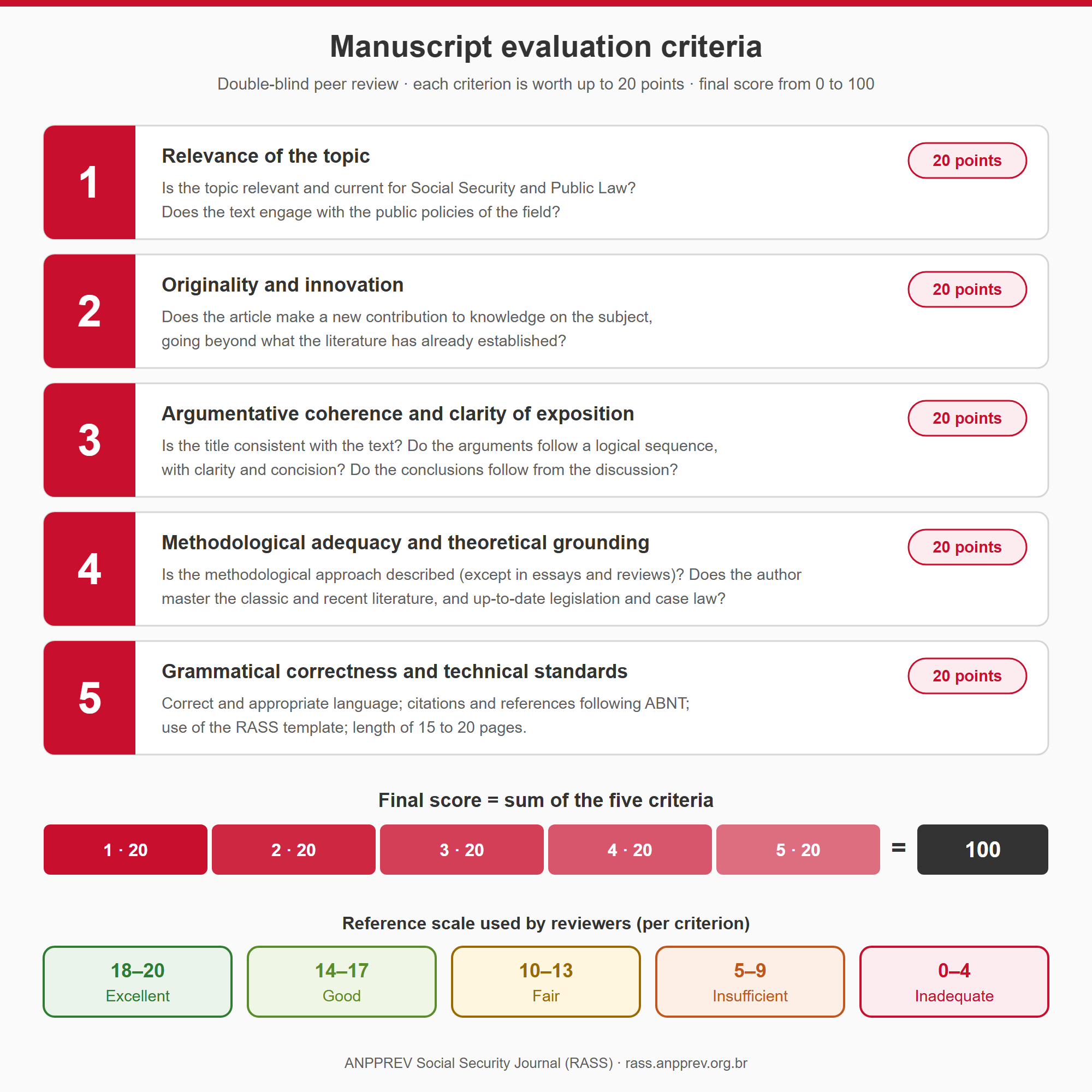
Manuscript evaluation criteria (click the image to enlarge)
How to submit
- Submissions are made exclusively through the journal's system; submissions by email are not accepted. To submit a manuscript, register as an author; after registering, the system will guide you through the submission steps.
- Submission, review and publication are free of charge: RASS does not charge authors any fees.
- Texts are accepted in Portuguese, English or Spanish.
- Mandatory template: open in Google Drive or download in Word (.docx).
Rejection at editorial screening
At the initial screening (desk review), the editors may reject a manuscript, before peer review, when it:
- falls outside the focus and scope of RASS or addresses a topic of very limited interest to the journal's readership;
- revisits a topic already covered in the literature without an original approach or new contribution;
- does not provide in-depth theoretical analysis or consider arguments contrary to the thesis defended;
- does not present a sufficient and up-to-date literature review on the topic;
- relies excessively on long direct quotations, without the authors' own contribution;
- does not comply with the formatting rules, the template or the requirements of these guidelines;
- has problems of writing, spelling, clarity or cohesion.
Originality and exclusivity
- Texts must be unpublished and submitted exclusively to RASS. Simultaneous submission to another journal is not permitted.
- Articles derived from master's dissertations and doctoral theses available in repositories are still considered unpublished, provided they have not yet been published as an article, chapter or book. In this case, state the origin of the research in "Comments for the editor" (and, after acceptance, in a note in the text).
- Once published in RASS, the article may be reproduced in books and collections, provided the original publication is cited, with its link or DOI.
Manuscript preparation
- Use the RASS template (Times New Roman 12, 1.5 line spacing) and submit the file in Word format (.doc or .docx).
- Name the file with the title of the work only (e.g., title.docx), without the authors' names.
- Title of up to 15 words; abstract of up to 200 words; 3 to 5 keywords. Title, abstract and keywords in Portuguese and English (and in Spanish, if the text is in that language).
- Follow the structure of the chosen section, described on the Submissions page.
- Citations in the author-date system (ABNT NBR 10520) and references according to ABNT NBR 6023, with a DOI or URL whenever available. Use footnotes only for brief explanations. Authors are responsible for the accuracy of the references.
- Tables, charts and figures must be editable and placed within the body of the text, numbered, with title and source.
- Remove all author identification from the text and from the file properties. For self-citations, use "Author, year".
- Proofread the text before submitting: the language must be appropriate for a scientific publication and, in Portuguese, follow the current Orthographic Agreement (quotations from earlier texts keep their original spelling).
- Declare in the methodology any use of generative artificial intelligence tools, stating the tool and the purpose of its use. AI tools cannot be listed as authors.
Metadata entry in the system
- Authors: full name, in the order in which they should appear in the publication.
- ORCID: mandatory for all authors, entered as a full URL (e.g., https://orcid.org/0000-0002-1825-0097).
- URL: link to the full CV; authors affiliated with Brazilian institutions must provide their Lattes CV.
- Affiliation: full name of the institution, followed by city, state and country. E.g.: University of Brasília (Brasília, DF, Brazil).
- Bio statement: position and institution, academic degrees (from highest to lowest) and professional activity, in up to 5 lines.
- Funding agencies: state the funding source, if the research was funded.
- Conflict of interest: declare whether or not there are conflicts of interest.
- References: paste the complete list of references of the article.
Research data
Articles based on empirical data (e.g., sets of court decisions or statistical databases) are encouraged to deposit the data in a public repository (such as Zenodo, Figshare or SciELO Data), cite the dataset in the references and include, at the end of the text, a "Data availability" section with the access link. Any ethical or legal restrictions on sharing must be reported at submission.
Ethics and integrity
RASS follows the guidelines of the COPE – Committee on Publication Ethics and its own Code of Ethics.
- Authorship and contributions: all authors must have taken part in the work sufficiently to take public responsibility for it. In co-authored papers, state in "Comments for the editor" each author's contribution according to the CRediT taxonomy (conceptualization, methodology, investigation, analysis, writing, review, etc.).
- Conflict of interest: authors, reviewers and editors must declare personal, commercial, political, academic or financial interests that could influence the preparation or evaluation of the work. A conflict does not in itself lead to rejection, but it must be declared. Reviewers with a conflict must recuse themselves, and the manuscript will be sent to another reviewer.
- Authors' responsibility: authors are responsible for the content, for the conduct and validity of the research and for the opinions expressed, and undertake to take part in the review and approval of the final version.
- Plagiarism and misconduct: all manuscripts undergo similarity checking (iThenticate). Signs of plagiarism, simultaneous submission, data manipulation or other misconduct will be investigated following COPE guidance.
- Corrections and retractions: errors identified after publication will be corrected through an erratum; in serious cases, the article may be retracted, following COPE guidance.
- Editors: texts by editors and members of the editorial team undergo the same double-blind review process, without any special treatment.
Review
Manuscripts undergo double-blind peer review, based on the criteria shown in the chart above. The step-by-step process is described on the Editorial Flow page.
Questions
If you have questions or difficulties with the submission, please write to cejud@anpprev.org.br.