Editorial Flow
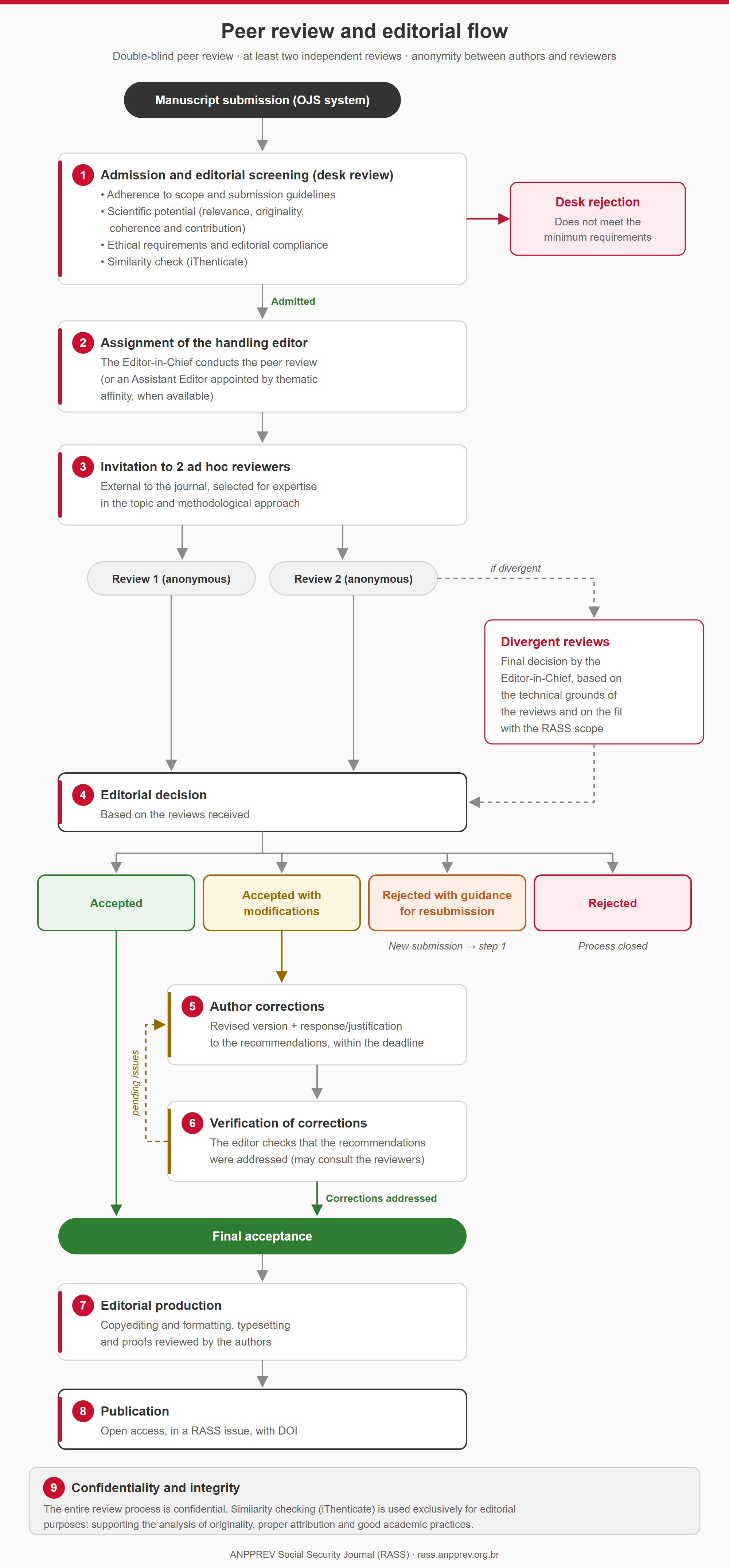
RASS editorial flow (click the image to enlarge)
Double-blind peer review and editorial flow
The ANPPREV Social Security Journal (RASS) adopts double-blind peer review, with at least two independent reviews, preserving anonymity between authors and reviewers throughout the process.
1) Admission and editorial screening (desk review)
After submission, the Editorial Board checks:
- adherence to the journal's scope and submission guidelines;
- the scientific potential of the text (relevance, originality, coherence and contribution);
- ethical requirements and editorial compliance;
- similarity, using iThenticate, to support academic integrity.
Manuscripts that do not meet the minimum requirements may be rejected at this stage.
2) Assignment of the handling editor
Once the manuscript is admitted, the Editor-in-Chief conducts the peer review or, when available, appoints an Assistant Editor by thematic affinity.
3) Invitation to reviewers
Two (2) reviewers external to the journal (ad hoc) are invited, selected for their expertise in the topic and methodological approach of the manuscript. Reviewers score the five evaluation criteria published in the Author Guidelines.
4) Editorial decision
Based on the reviews, the decision may be:
- accepted;
- accepted with modifications;
- rejected with guidance for resubmission (a new submission, which restarts the process at step 1);
- rejected.
In the case of divergent reviews, the final decision rests with the Editor-in-Chief, taking into account the technical grounds of the reviews and the fit of the manuscript with the policies and scope of RASS.
5) Author corrections
When a manuscript is accepted with modifications, the authors submit, within the deadline set by the editors, the revised version together with a response or justification to the recommendations.
6) Verification of corrections
The editor checks that the recommendations were addressed and may consult the reviewers. If issues remain, the text returns to the authors; once the corrections are addressed, the manuscript receives final acceptance.
7) Editorial production
After final acceptance, the text undergoes copyediting and formatting, typesetting and proofs reviewed by the authors.
8) Publication
The article is published in open access, in a RASS issue, with a DOI.
Confidentiality and integrity
The entire review process is confidential. Similarity checking (iThenticate) is used exclusively for editorial purposes: supporting the analysis of originality, proper attribution and good academic practices.